
Who is Judge Kim Wanker?
Kim’s Personal Background
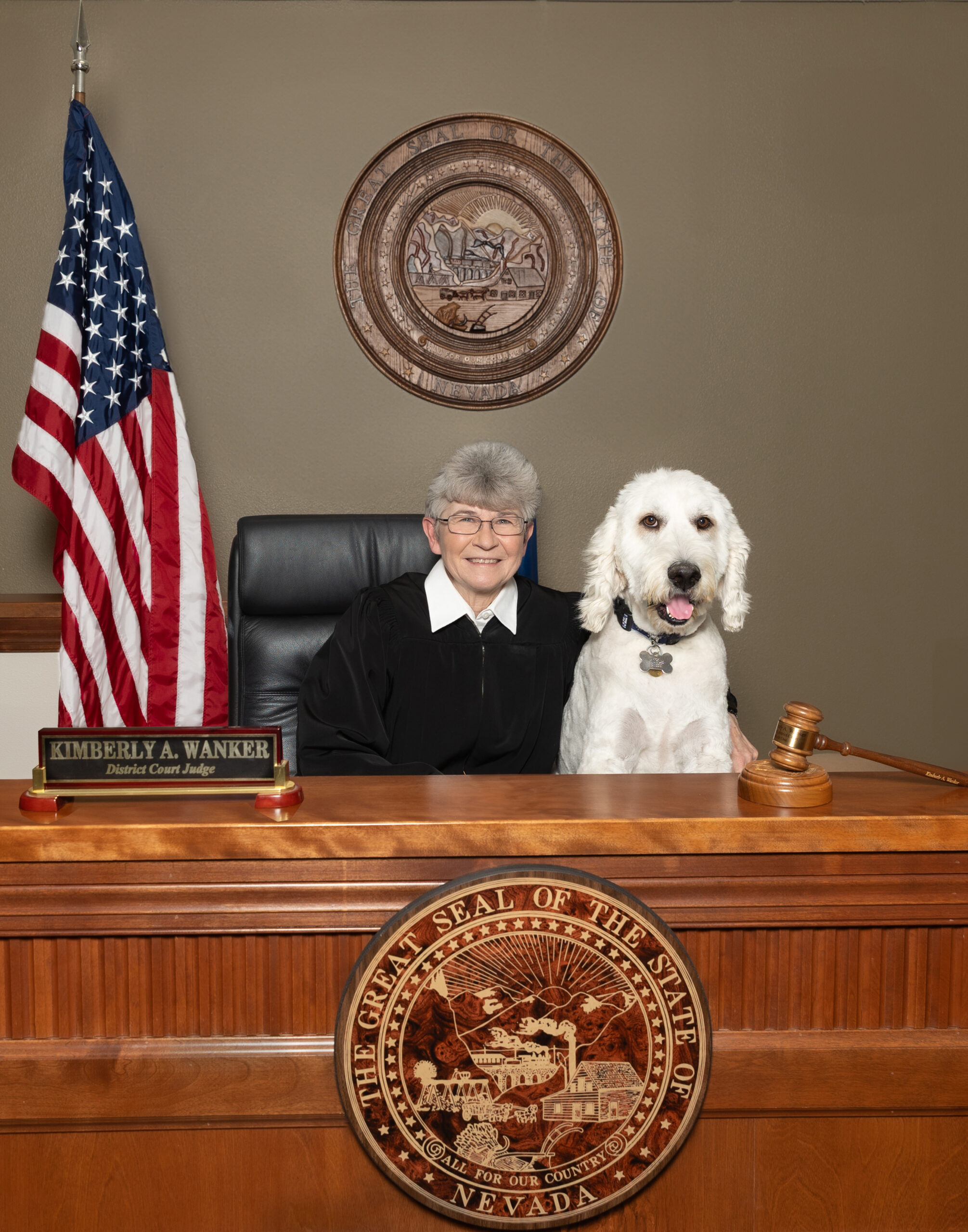
Kim was born in Kansas, studied from grade school through law school in Nebraska, spent two years in Colorado practicing law, and relocated to Nevada in 1989, where she practiced law from 1989 until July 1, 2011, when she became the first rural female district court judge in Nevada history. For the past 15 years, Kim has served as the Fifth Judicial District Court Judge for Department 1.
Kim bought her first home in Pahrump in March 2006 and still owns it. She now resides on 10 acres there, inspired by her passion for old cars and animals. Kim started visiting Pahrump in the early 1990s to race at Rupert Bragg-Smith’s track, enjoying various road racing and autocross events. After the track was sold in 2005 and renamed Spring Mountain Motorsports Ranch, she continued racing both cars and karts at the facility.
In 2009, Kim decided to follow her passion for classic cars. One of her favorites is a fully restored and re-painted 1967 21 Window VW Bus, which is now awaiting new upholstery so it can be shown at car shows and parades. She also still has the 1965 Ford Mustang Convertible her parents bought brand new, and in which she learned to drive. Kim’s love for vintage vehicles includes a Formula Vee Formcar racecar. She also enjoys vintage convertibles like the 1973 Super Beetle Convertible and the 2002 Porsche Boxster convertible.
Kim is passionate about animals. She owns four rescue dogs and a rescue cat. Leo, her oldest dog, is a trained service animal, and turns 10 in June. Kim’s dog Chance was severely emaciated and rescued from a kill shelter in Hesperia, California in September 2025 by Pat from Never Forgotten Animal Society. When Pat rescued Chance, the dog weighed 47 pounds. Kim adopted Chance. Currently, he has reached a healthy weight of 92 pounds. Chance now serves as the official dog for the Fifth Judicial District Court and Drug Court.
Kim is an enthusiast of outdoor activities. Her interest in cycling is reflected in her collection of diverse bicycles, which includes road, mountain, gravel, and electric models. In addition, she participates in poker runs with her ATV and enjoys golfing in the company of friends. She also enjoys boating, wakeboarding, and tubing. Kim also loves flea markets and garage sales, and has been going to Canton Trade Days in Canton, Texas —the world’s largest flea market—for more than 43 years.
Kim now is the primary caregiver to her elderly parents – who live with Kim and have been married for over 67 years.
Kim has always given back to her community. While in Las Vegas, Kim was an active member of Community Lutheran Church where she attended various bible studies and participated in various youth activities, including teaching vacation bible school, and participating in food and water distribution for the homeless.
Since 2011, Kim has maintained an active presence within the communities of Nye and Esmeralda Counties. She participates in organizations such as Rotary, Soroptimists, Daughters of the American Revolution, Friends of the Belmont Courthouse, the Pahrump Chamber of Commerce, Sleep in Heavenly Peace, Nye Communities Holiday Task Force, the Federation of the Blind, the Martin Luther King Foundation, among many other local groups and initiatives.
Additionally, Kim regularly supports and attends fundraising activities benefiting various charitable causes, including schools, animal welfare organizations, and programs for individuals with disabilities. Kim has received several community awards including, but not limited to, the Ms. Senior Golden Years USA Sally La Rocca Courage Award, the Butch Harper Act of Kindness Award; and, she was selected in 2022 as the Grand Marshall of the Nye Communities Coalition Fourth of July Parade.



Kim Wanker’s Judicial Philosophy
The role of a District Judge is threefold – Adjudicator, Manager, and Community Leader.
Adjudicator
As an Adjudicator, Judge Kim considers it her responsibility to be thoroughly prepared for every matter presented before her. She diligently reviews each case file in its entirety prior to presiding over any proceedings and conducts all necessary legal research personally, rather than relying on a law clerk. Her guiding principle as a private attorney was “always outnumbered, never out prepared,” and she continues to apply this philosophy as a District Judge. Similarly, Judge Wanker possesses extensive training in electronic research techniques and demonstrates comprehensive knowledge of both factual and legal aspects pertaining to all matters before the court. Judge Kim maintains that the judge should be the most prepared individual in the courtroom.
Ultimately – who do you elect – a judge or a law clerk?
A District Court Judge’s role is circumscribed by law. When statutes or regulations are clear and unambiguous, the judge is obligated to apply the law as written, independent of personal opinions regarding its wisdom. In instances where the law is vague or ambiguous, the judge must examine the legislative history to determine the intent behind the statute or regulation. This process involves analyzing relevant statutes, committee minutes, and background documentation to discern legislative intent, and subsequently applying the law accordingly.
Manager
As a District Judge, Kim serves as an administrator responsible for managing the court’s docket, caseload, personnel, and various divisions within the judicial department, including budget oversight, maintenance of the law library, and supervision of specialty courts such as the drug court.
Judge Kim upholds an open-door policy to ensure transparency with both her staff and the community she represents. She exemplifies leadership by setting high personal standards and does not assign any task to her staff that she would not undertake herself. Judge Kim is committed to working diligently alongside her team and maintains a visible presence at courthouses within the judicial district during business hours.
Community Leader
Judge Kim sees leadership across the Fifth Judicial District as a core responsibility. She attends local events, engages with community organizations, and regularly supports area non-profits and other organizations throughout the Fifth Judicial District. Judge Kim is not a CEO – a campaign event only – participant. She is seen working and supporting her communities year-round – not just during election cycles.
Judicial Focus
- Judge Kim takes a very tough stance on crime. Kim believes in holding individuals accountable and responsible for their actions. Kim tells each person convicted of a crime that probation is a privilege, not a right, and that if they do receive probation – they will return to her courtroom for revocation proceedings, should they violate any of their terms of probation. She also informs the individual that their own conduct will determine whether they succeed on probation, or are returned to for revocation proceedings. In all court matters, Kim expects the parties, and their counsel to be thoroughly prepared – as to the facts, the law, and the court rules. She has sanctioned parties for lying to the court, and has also sanctioned attorneys’ for improper conduct.
- Judge Kim assumed leadership of the Pahrump Adult Drug Court on August 1, 2011. She requires all unemployed participants to perform a minimum of 20 hours of community service each week for a non-profit organization. Since many participants have lost their privilege to drive, Kim instituted a used bicycle program, whereby an individual participant is given a used bicycle, which has been donated and refurbished by a court volunteer, as a means of transportation to and from drug court and community service. Kim is proud to say that she is a tough, but fair, no nonsense judge.
- As a Judge, Kim Wanker is always trying to improve the delivery of services provided by the Fifth Judicial District Court. She is currently working on a program to turn the Fifth Judicial District Court into a leader in technology in the Courtroom. Kim is thoroughly familiar with electronic court filings, having done the same in both the federal courts and the state courts in Nevada, Colorado and Arizona. It is her goal for the Court to be able to transition to electronic filing capabilities in the future.